

02 Sep Automating Compliance Quality Control: Introducing Qompli
Automating Compliance Quality Control: Introducing Qompli
Detect, review and fix have always been separate jobs. Putting them in one place changes the arithmetic.
When Superman opened in July 2025, audiences in India saw a different film from audiences in London: the Central Board of Film Certification had cut two kissing scenes, including a 33-second mid-air kiss from the trailers, to secure a UA (13+) rating. Two years earlier, Oppenheimer shipped to India and the Middle East with a CGI dress added over a nude scene. None of this is unusual. Put content in front of a global audience and the same title becomes many versions, each of which has to be checked.
Here’s what’s odd about it. Most other steps in the content supply chain – transcode, file QC, captioning, packaging, delivery – have seen serious automation over the years. Compliance has seen far less of it. It isn’t for lack of trying. Until recently the machines weren’t good enough. And the job has never been purely about detection – somebody still has to decide. That second part is what most AI pitches quietly skip.
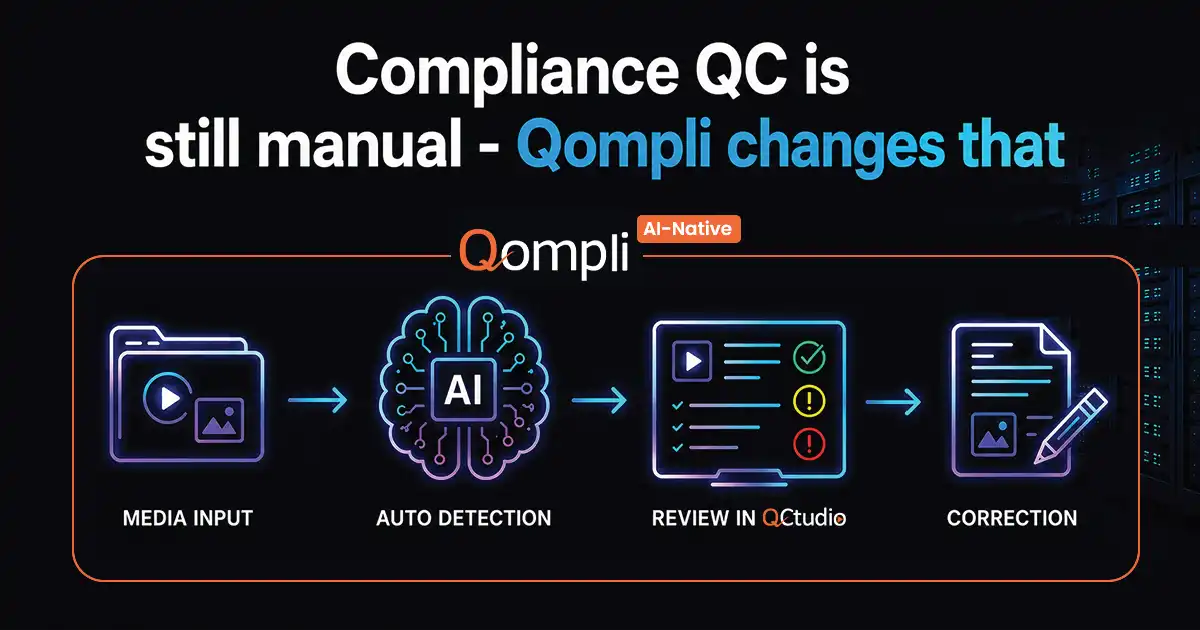
We built Qompli around both halves. Today we’re launching the first version: automated compliance QC, review, and correction, covering smoking, alcohol, nudity (explicit and soft), and audio profanity. Further categories are already in development.
The rules are getting stricter, and they aren’t converging.
There is no single global standard, and nothing suggests one is coming. Jurisdictions are tightening, each in its own direction.
- United States – the FCC’s maximum forfeiture for broadcasting obscene, indecent or profane material stands at $508,373 per violation, and it has counted separate incidents inside one program separately.
- United Kingdom – Ofcom’s Broadcasting Code sets a 9pm watershed and bars the most offensive language before it, and Ofcom has acted on more than 300 occasions since 2003.
- European Union – Article 6a of the Audiovisual Media Services Directive requires member states to restrict content that may impair minors’ development. Twenty-seven states transpose it twenty-seven ways.
- India – wherever tobacco appears, a static health warning must sit at the bottom of the screen for the entire duration of every scene showing it, on top of 30-second health spots and a 20-second disclaimer.
- UAE – Federal Decree-Law 55 of 2023 backs content standards with fines up to AED 1 million, doubled on repeat, and reaches businesses outside the UAE delivering content into it.
- Saudi Arabia – the General Authority for Media Regulation clears content, trailers and posters separately. Nothing screens until approved.
- Malaysia – the censorship board approved Lightyear on condition that scenes and dialogue be “cut and muted.” The distributor declined, and it didn’t release there.
Different regulators, different categories, different remedies. What they share is a direction of travel, and it is one way.
The efficiency problem is worse than the headline
A 90-minute title does not take 90 minutes to review. Runtime is the floor – what you’d spend if the reviewer never stopped, never rewound and never wrote anything down. Nobody reviews that way. They pause to log a timecode, scrub back to check whether that thing in the background really is a bottle, mark the in-point, hunt for the out-point, then find their place again. Real passes run well past runtime, and on dense content to a multiple of it.
Then multiply by the compliance categories on your checklist, and again by the markets you serve. A modest library going to eight territories generates far more review hours than the content itself contains.
The density is high, too. A US analysis of shows popular with adolescents found programs rated TV-14 averaged nearly 21 alcohol incidents an hour, plus at least one tobacco incident; in the UK, alcohol imagery appears in over 40% of prime-time broadcasts on the five most popular channels, about as often before the 9pm watershed as after. Twenty-one events an hour is not a flag on a title. It’s a hundred-plus decisions in a feature-length program, each needing a timecode.
Take India’s static-warning requirement. It isn’t enough to know a film “has smoking in it” – you need every in-point and out-point of every tobacco moment, accurate to the frame, because a graphic must sit on screen for exactly those durations. Get it wrong and you’ve broken the law or defaced a scene that didn’t need it. That’s not a creative judgement; it’s data collection, and humans are expensive and inconsistent at that.
Regulators are responding to real evidence, incidentally. Truth Initiative – the US public health non-profit created by the 1998 tobacco Master Settlement Agreement – found tobacco depictions in 60% of the fifteen most popular streaming shows among 15-to-24-year-olds, reaching an estimated 25 million young people in a single year.
And there’s the cost nobody puts on a slide: rework. Miss something and the fix happens late, under deadline pressure, at a rate that makes the original review look cheap.
Automation first, realistically
Models can find cigarettes, bottles, exposed skin, and profane words in an audio track, and return them as timed events rather than a vague flag on a title. But how well they do it is the whole foundation, and accuracy cuts both ways. A miss is a compliance breach. A false positive is wasted review time – and enough of those and your team stops trusting the list, goes back to watching everything, and you’ve bought nothing.
This is where general-purpose video AI tends to disappoint. A model built to recognise thousands of concepts across all of video is, by construction, shallow on any single one. It will tell you a scene contains a bottle; it is far less reliable at telling a beer bottle from a water bottle at the back of a dim frame, or catching the cigarette lit for four frames. Compliance detection is a narrow problem, and narrow problems reward purpose-built models – trained on the specific categories, the edge cases, and the footage broadcasters actually deliver. That’s the bet behind Qompli: a few categories done properly, not everything done approximately.
Still, even a detector that finds everything hasn’t finished the job. It tells you where to look; it can’t tell you what to do about what it finds – and that gap doesn’t close with a better model. Three reasons:
1. Context decides, not pixels. A detector sees a cigarette and reports a cigarette. It can’t see that in one program the cigarette is B-roll in a news segment on tobacco regulation, and in the next it’s in the hand of the hero, lit in slow motion and shot to look good. Both come back as “smoking detected.” Only one is what regulators worry about – and depiction versus glamorisation, a judgement written into these rules, isn’t visible in the frame.
2. Thresholds are commercial decisions. How much soft nudity is acceptable depends on the platform, the rating, the market, and sometimes the specific contract. That’s not a model parameter. It’s a person.
3. Somebody signs. When a broadcaster is exposed to a six-figure penalty, a named human approves the delivery. That won’t change, and it shouldn’t.
The right design isn’t automation instead of people. It’s automation that hands people a short, precise, pre-sorted list of decisions – and then gets out of the way.
Review that actually saves time
This is where most tools give back the gains they promised. If your AI produces a spreadsheet of 400 timecodes and your reviewer has to scrub to each one by hand, nothing has been saved. The work has just moved.
Review in Qompli happens in QCtudio, our collaborative review platform, built on one idea: less watching, more deciding. Every detection lands as a navigable event on a timeline. Reviewers jump straight to the moment, at frame and shot level, and mark it verified or false positive, adding comments where a judgement needs explaining and their own alerts where the machine missed something. Several people can work one title, with approvals tracked across the team.
Here’s the part that changes the arithmetic. The reviewer doesn’t just decide whether something is a violation – they decide the fix at the same moment, and see it. One click drops a warning graphic at a precise position in the frame. One click blurs the exposed region. One click mutes or beeps the offending word. The correction renders in the preview immediately, so the reviewer sees the actual result rather than imagining it.
It scales past one-at-a-time, too. A fix can go on the violation in front of you, or on every violation of that type across the title in one action. For a film with sixty tobacco moments needing the same statutory graphic, that’s one decision instead of sixty. By the time the reviewer reaches the end of the list, the fixes are specified and approved. A final confirmation playback runs at up to 6x real time, so nothing slips past unseen.
Manual review is linear: you sit through the uneventful 85% to reach the 15% that matters. Everything here is logged, too, which matters when a regulator asks who approved what and why.
Correction: fixing the content, not just describing the problem
This is what separates a compliance tool from a compliance system. A report tells you there’s a problem; it doesn’t solve it. Someone still has to open an edit session, find the moments again and make the fixes – the expensive, deadline-threatening step the exercise was meant to avoid.
Because the fixes were specified during review, correction isn’t a fresh round of decisions – it’s rendering what the reviewer approved:
- Warning and disclaimer graphics, held for exactly the durations the detections define – including statutory messages that must persist through a whole scene.
-
Blurring, applied to the specific regions and frames that need it.
-
Mute or beep, timed to the word rather than smeared across the sentence.
Critically, corrections are rendered into the original content, not a low-resolution. Qompli renders to a copy, so your source is never overwritten and the clean master stays intact for markets needing different treatment, or none. And rather than imposing its own encode, it works with the transcoder you already use, so wrapper, metadata, track layout and structure come out the way your pipeline expects.
Prefer to correct in your own environment? Confirmed alerts export as a timeline your editing system can open, so the fix starts where the flag was.
Where it runs
Deployment is often the first question a customer asks. Compliance work happens on unreleased, embargoed material that carries a contractual penalty if it leaks.
Qompli launches as a cloud system, with an on-premise version scheduled for the near term, because a significant share of our customers needs it – for three different reasons.
- For some it’s content security: their policy doesn’t permit pre-release material leaving their own infrastructure, and no amount of encryption-in-transit changes that answer.
- For others it’s the law: a growing number of countries require content to be stored within their borders, and if no established cloud provider runs a data centre there, the cloud isn’t an option at all.
- And for others it’s arithmetic – at large, steady volume, owning the compute costs less than renting it.
None of this makes the two mutually exclusive. Hybrid deployment lets you keep routine work on your own hardware and burst to the cloud when a deadline lands, so you’re not sizing infrastructure for the busiest week of the year.
Familiar ground for us: Venera has shipped on-premise QC alongside cloud for years.
Where this goes
Version one covers smoking, alcohol, nudity, and audio profanity – the four categories our customers raise most often, and where regulatory pressure is sharpest today. More categories are on the way, prioritised by where our customers and their regulators are pushing hardest.
The broader point is the shape of the thing. Automation does the volume work, people do the judgement, and nobody does the same title twice.
Automation does the volume work, people do the judgement, and nobody does the same title twice!
Qompli is available now from Venera Technologies as a cloud service, with on-premise deployment scheduled for the near term. To see it running on your own content, get in touch.
Regulatory references
United States – Maximum forfeiture of $508,373 per violation, capped at $4,692,668 for a single continuing violation, where a broadcast licensee has broadcast obscene, indecent, or profane material: 47 CFR § 1.80(b)(1) — https://www.ecfr.gov/current/title-47/chapter-I/subchapter-A/part-1/subpart-A/subject-group-ECFRe23796df9028e47/section-1.80
United States – Separate violations counted within a single program: FCC notice of apparent liability proposing the then-maximum forfeiture for each of 26 apparent indecency violations, 2004 – https://transition.fcc.gov/bureaus/eb/News_Releases/DOC-243249A1.html
United Kingdom – Rule 1.14 on the most offensive language before the watershed: Ofcom Broadcasting Code, Section One – https://www.ofcom.org.uk/tv-radio-and-on-demand/broadcast-standards/section-one-protecting-under-eighteens
United Kingdom – The 9pm watershed, and Ofcom action on more than 300 occasions since 2003 – https://www.ofcom.org.uk/tv-radio-and-on-demand/broadcast-standards/what-is-the-watershed
European Union – Article 6a of the Audiovisual Media Services Directive (Directive (EU) 2018/1808) on protection of minors, and its national transposition – https://digital-strategy.ec.europa.eu/en/policies/avmsd-protection-minors
India – Tobacco depiction rules extended to online curated content in 2023: 30-second health spots, 20-second audio-visual disclaimer, and a static on-screen warning during display of tobacco products – https://techcrunch.com/2023/05/31/india-tobacco-glorification-streaming-platforms/
India – 2024 draft amendment rules and the June 2025 stakeholder consultation on non-skippable spots and platform-open disclaimers – https://www.medianama.com/2025/06/223-ott-tobacco-depiction-rules-final-consultation-mohfw/
United Arab Emirates – Federal Decree-Law No. 55 of 2023 on media regulation: national content standards, and administrative fines from AED 1,000 to AED 1,000,000, doubled on repeat offences to a maximum of AED 2,000,000 – https://uaelegislation.gov.ae/en/legislations/2145
United Arab Emirates – Executive Regulations in force since October 2024, penalty tiers, and application to media businesses outside the UAE delivering content into it – https://www.tamimi.com/law-update/technology-edition/articles/media-law-and-advertising-standards-in-the-uae-key-rules-and-restrictions/
Saudi Arabia – Separate clearance processes for film content classification, trailers and posters: General Authority for Media Regulation – https://gmedia.gov.sa/en/services
Malaysia – Film Censorship Act 2002 (Act 620) for film and television, and the Communications and Multimedia Act 1998 for online content. LPF decision ordering scenes and dialogue in Lightyear to be “cut and muted” – https://www.malaymail.com/news/malaysia/2022/06/17/film-censorship-board-decision-to-cancel-screening-of-lightyear-movie-made-by-distributor/12829
