

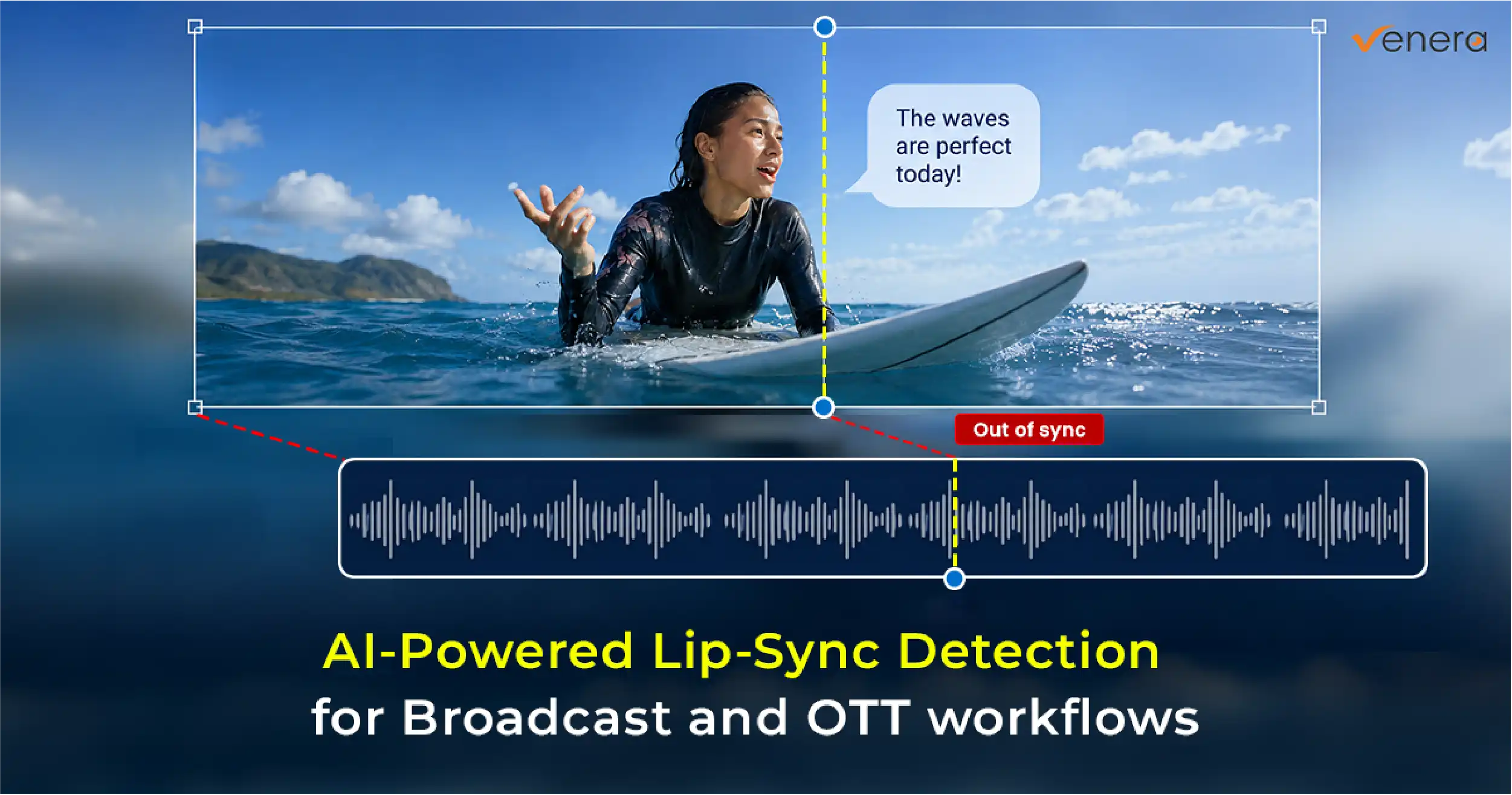
10 Jun AI-Powered Lip-Sync Detection for Broadcast and OTT workflows
AI-Powered Lip-Sync Detection for Broadcast and OTT workflows
Click Play to listen to the article
Introduction
As media supply chains become increasingly complex, ensuring high-quality viewer experiences has become more challenging than ever. Broadcasters, OTT platforms, post-production facilities, localization providers, and content owners invest significant effort in validating technical quality before content reaches audiences. Among the various quality issues that can negatively impact viewer experience, lip-sync errors remain one of the most noticeable and frustrating.
Even a slight mismatch between a speaker’s lip movements and the corresponding audio can immediately distract viewers and reduce engagement. Unlike many technical defects that go unnoticed by general audiences, lip-sync issues are often obvious even to non-technical viewers.
While lip-sync verification has traditionally relied on manual review, the rapid growth in content volumes across OTT, FAST channels, localization projects, and content archives has made this approach increasingly impractical.
In this blog, we explore common types of lip-sync issues, their causes, the challenges associated with manual detection, and how automated solutions such as Quasar® can help media organizations address these problems efficiently.
What is Lip-Sync?
Lip-sync, short for “lip synchronization,” refers to the alignment between spoken audio and the visible mouth movements of a person on screen.
When audio and video are properly synchronized, viewers perceive speech naturally. However, when synchronization is lost, viewers may notice that speech occurs before or after the corresponding lip movement, creating a distracting viewing experience. Lip-sync issues can occur in content intended for broadcast, OTT delivery, post-production workflows, localization projects, and even archived content libraries.
Common Types of Lip-Sync Issues
1. Audio Leads Video
In this scenario, viewers hear speech before the speaker’s lips begin moving. Even relatively small offsets can become noticeable during close-up dialogue scenes. Audio-leading-video issues are often introduced during transcoding, packaging, or playback processing.
2. Video Leads Audio
This is the most commonly recognized lip-sync problem. The viewer sees the lips move first, followed by the audio. The effect can be highly distracting, particularly during interviews, news broadcasts, dialogue-heavy programs, and dramatic scenes.
3. Progressive Lip-Sync Drift
Drift occurs when content starts in sync but gradually moves out of sync as playback progresses.
For example, the first few minutes of a movie may appear perfectly synchronized, while the final portion of the content exhibits significant lip-sync errors.
Drift is particularly problematic because spot-checking the beginning of a title often fails to detect the issue.
4. Segment-Specific Lip-Sync Issues
Sometimes lip-sync issues are introduced at a specific point in the content, often due to editing, splicing, content replacement activities, or workflow processing errors.
For example, a video editor may modify the video track but inadvertently fail to make the corresponding adjustment in the audio track. In such cases, synchronization may be correct before the edit point but become misaligned afterwards.
These issues can be difficult to identify without reviewing the content beyond the affected segment.
Common Causes of Lip-Sync Issues
1. Frame Rate Conversions
Frame rate conversion remains one of the most common causes of synchronization problems.
For example, if content originally produced at 23.976 fps is converted to 29.97 fps and the video duration changes without corresponding adjustments to the audio, synchronization issues can occur.
Another common source of error involves confusion between drop-frame and non-drop-frame timecode calculations, leading to cumulative timing discrepancies.
2. Transcoding and Packaging Issues
Modern media workflows often involve multiple transcoding, packaging, and delivery stages. In some workflows, video and audio assets may be processed independently before being combined later in the pipeline. Timing discrepancies introduced during these operations can lead to lip-sync problems in the final deliverable.
3. Server-Side Ad Insertion (SSAI)
SSAI has become increasingly common in OTT workflows. While SSAI enables personalized advertising experiences, it also introduces additional opportunities for synchronization errors. Timing mismatches between content segments and inserted advertisements can occasionally result in audio-video synchronization problems.
4. Editing Operations
Editing remains a frequent source of lip-sync issues. A simple change made to a video track without a corresponding adjustment to the audio track can create synchronization errors. As content passes through multiple post-production stages and vendors, the likelihood of such errors increases.
5. Dubbing and Localization
Localization workflows introduce a unique set of lip-sync challenges. Even when translated dialogue accurately conveys the original meaning, differences in language structure, sentence length, pronunciation, and speech pacing can make it difficult to align dialogue perfectly with visible mouth movements.
Many viewers have experienced this while watching dubbed versions of international content where speech timing does not precisely match the actor’s facial movements. As global streaming platforms continue to distribute content across multiple regions and languages, maintaining synchronization quality in dubbed content has become increasingly important.
6. Other Workflow Factors
Additional causes may include:
- Timebase inconsistencies
- Broadcast playout processing
- Metadata-related timing issues
- Audio resampling errors
- Playback device processing delays
The Viewer Impact of Lip-Sync Issues
Lip-sync issues are among the few technical defects that can be immediately recognized by non-technical viewers.
Several high-profile streaming releases have generated viewer complaints related to synchronization issues, particularly when content exhibited noticeable drift or playback-related sync offsets. In some cases, viewers have taken to social media to report that dialogue appears disconnected from the actors’ facial movements, creating a distracting and less immersive viewing experience.
The problem becomes even more apparent in dialogue-heavy content such as dramas, interviews, documentaries, news programming, and talk shows, where viewers naturally focus on facial expressions and speech.
For content owners and distribution platforms, even isolated synchronization issues can impact brand perception, increase support requests, and negatively affect audience satisfaction.
Why Manual Detection Has Become Increasingly Challenging
Historically, lip-sync verification required operators to watch content manually. However, today’s media landscape presents several challenges:
- Growing OTT and FAST channel libraries
- Large volumes of episodic content
- Increasing localization requirements
- Extensive content archives
- Tight delivery schedules
- Multiple versions of the same title
Reviewing every title from beginning to end is often impractical.
This challenge becomes even greater when dealing with drift-related issues, since content may appear perfectly synchronized during the initial portion of the asset. Operators performing spot checks can easily miss problems that emerge later.
Similarly, edit-induced synchronization issues may only become apparent after a specific edit point, requiring lengthy manual review sessions. As content libraries grow from hundreds to thousands of assets, organizations need scalable methods to validate synchronization quality without increasing operational costs.
Automated Lip-Sync Detection with Quasar®
To help media organizations address these challenges, Venera Technologies has introduced AI-powered lip-sync detection in Quasar®. Using advanced AI models, Quasar analyzes the relationship between spoken audio and visible facial movements to identify lip-sync discrepancies within media assets. This automated approach enables organizations to validate content more efficiently than traditional manual review methods.
Quasar’s lip-sync analysis helps identify synchronization issues that may result from frame rate conversions, editing operations, transcoding workflows, packaging processes, localization activities, and other stages of the media supply chain.
By automating lip-sync verification, media organizations can efficiently process large content volumes, including OTT libraries, broadcast deliverables, localized content, and archive assets, while reducing the need for exhaustive manual review.
As content volumes continue to grow, AI-driven automation plays an increasingly important role in maintaining quality standards and ensuring a consistent viewing experience across distribution platforms.
Reviewing Lip-Sync Issues with QCtudio®
Detection is only one part of the workflow. Once analysis is completed, users can leverage QCtudio®, Venera’s review and collaboration platform, to review reported lip-sync issues.
QCtudio enables operators to:
- Review identified synchronization issues quickly
- Navigate directly to reported locations
- Validate findings visually
- Collaborate with internal teams
- Share review results with content suppliers and clients
- Accelerate decision-making and issue resolution
This integrated workflow significantly reduces the time required to identify, review, and resolve synchronization issues.
By combining automated analysis with efficient review and collaboration, organizations can streamline content QC operations while maintaining high quality standards.
Benefits of Automated Lip-Sync Detection
Automated lip-sync detection provides several operational advantages:
✔ Improved Efficiency
Eliminates the need for operators to watch every asset from beginning to end solely for synchronization verification.
✔ Better Scalability
Supports growing OTT, broadcast, localization, and archive content volumes without proportional increases in staffing.
✔ Earlier Issue Detection
Identifies synchronization problems before content reaches distribution platforms and viewers.
✔ Consistent Quality Standards
Applies the same analysis methodology across all content, reducing dependence on subjective manual review.
✔ Faster Collaboration and Resolution
Combined with QCtudio, enables efficient review, collaboration, and corrective action across distributed teams.
✔ Reduced Operational Costs
Helps organizations manage increasing content volumes without significantly expanding QC resources.
Conclusion
Lip-sync issues remain one of the most visible technical quality problems in modern media workflows, negatively impacting viewer experience, and potentially affecting audience engagement and satisfaction.
As content volumes continue to grow, manual review alone is no longer sufficient. AI-powered automation enables media organizations to identify lip-sync issues efficiently, helping ensure higher-quality content delivery while significantly improving operational efficiency.
With Quasar® and QCtudio®, Venera Technologies provides an integrated solution that combines automated detection, streamlined review, and collaborative decision-making – helping media organizations maintain quality at scale while delivering the viewing experience audiences expect.
